Winterizing Air Lines in Cold Environments
Winterizing Your Air Lines: Preventing Moisture Freeze-Up in Cold Environments
As the temperature drops, the stakes for your pneumatic systems rise. If you’ve ever dealt with a frozen solenoid valve or a sluggish cylinder in the middle of a January shift, you know that moisture is the enemy of productivity.
At PneumaticsNow.com, we want to ensure your operations stay fluid, even when the world outside is frozen. Here is everything you need to know about preventing moisture freeze-up in cold environments.
Why Winter Is Hard on Air Lines
It’s a simple law of physics: Warm air holds more water than cold air. When your compressor pulls in ambient air and compresses it, the air gets hot. As that air travels through your lines and encounters cold outdoor or warehouse temperatures, it cools rapidly. This causes the water vapor to condense into liquid droplets. If the temperature of the pipe drops below 32°F (0°C), that liquid becomes ice, leading to:
- Total blockages in air flow.
- Seal damage from ice crystals.
- Corrosion inside metal piping.
- System downtime and expensive repairs.

3 Pillars of Winterization
1. Master the Dew Point
The goal of winterization is to ensure your Pressure Dew Point (PDP) is lower than the lowest temperature your pipes will encounter. If your shop hits 20°F, your air needs a dew point of around 10°F to stay dry.
- Refrigerated Dryers: Great for indoor use, but they usually only reach a dew point of about 35°F to 39°F.
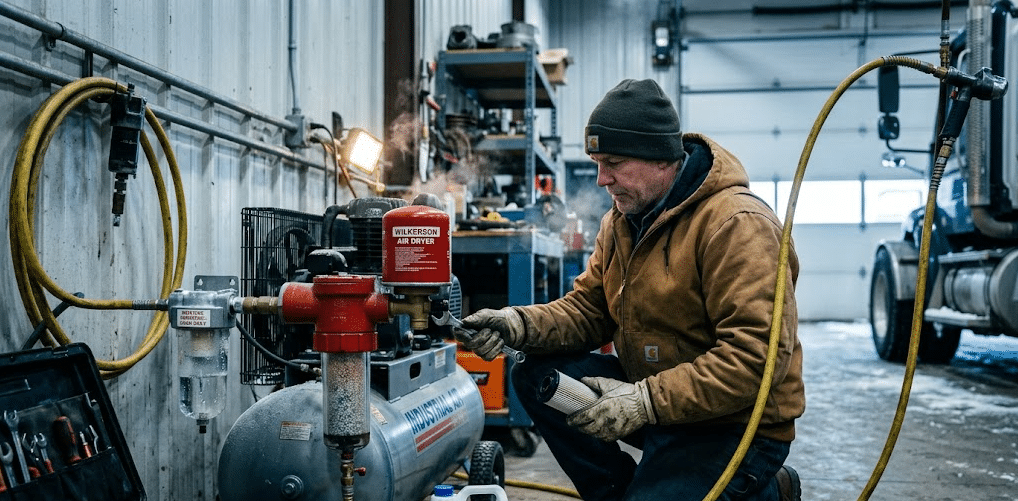
- Desiccant Dryers: The gold standard for winter. These can achieve dew points as low as -40°F or even -100°F, ensuring no liquid water ever forms in the lines.
2. Strategic Drainage
Even the best dryers can’t catch everything if your drainage system fails.
- Auto-Drains: Check your electronic or float-style drains daily.
- Slope and Pitch: Ensure your main headers are pitched back toward the compressor or toward a specific drop leg with a drain valve.
- Point-of-Use Filters: Install high-quality water separators immediately before your most sensitive equipment.
3. Insulation and Heat Tracing
If you have lines running between buildings or along exterior walls, passive protection might not be enough.
- Pipe Insulation: Slows the cooling process but doesn’t stop it entirely.
- Heat Tape / Trace: For extreme environments, electric heat tracing keeps the pipe temperature above freezing, preventing any residual moisture from turning into ice.
Checklist: Pre-Winter Maintenance
Before the first frost hits, run through this quick audit:
| Component | Action |
|---|---|
| Desiccant | Check the color; if it’s saturated (usually turns pink or clear), replace it. |
| Receiver Tank | Manually drain the tank to clear built-up sludge. |
| FRL Units | Clean the bowls of your Filter-Regulator-Lubricator sets. |
| Air Leaks | Fix them now. Leaks increase the cycle rate of the compressor, leading to more heat and more condensation. |
Final Pro Tip: Use the Right Lubricant
In cold weather, standard pneumatic oil can become viscous and gummy, causing valves to stick. Switch to a low-temperature synthetic pneumatic oil that maintains its flow characteristics when the mercury drops.
Don’t let a freeze-up bring your production to a halt. A little preparation in the fall saves a lot of thawing in the winter.
Put Your Winterization Plan Into Action
Now that you understand how moisture affects compressed air systems in cold environments, it’s time to make sure your operation is prepared before freezing temperatures arrive.
From desiccant dryers and filtration systems to drains, regulators, valves, and replacement components, Pneumatics Now offers the products and expertise needed to keep your compressed air system performing at its best.
Have questions or need equipment? Reach out to the team at Pneumatics Now for personalized recommendations, technical support, and pricing on the pneumatic products your operation depends on.