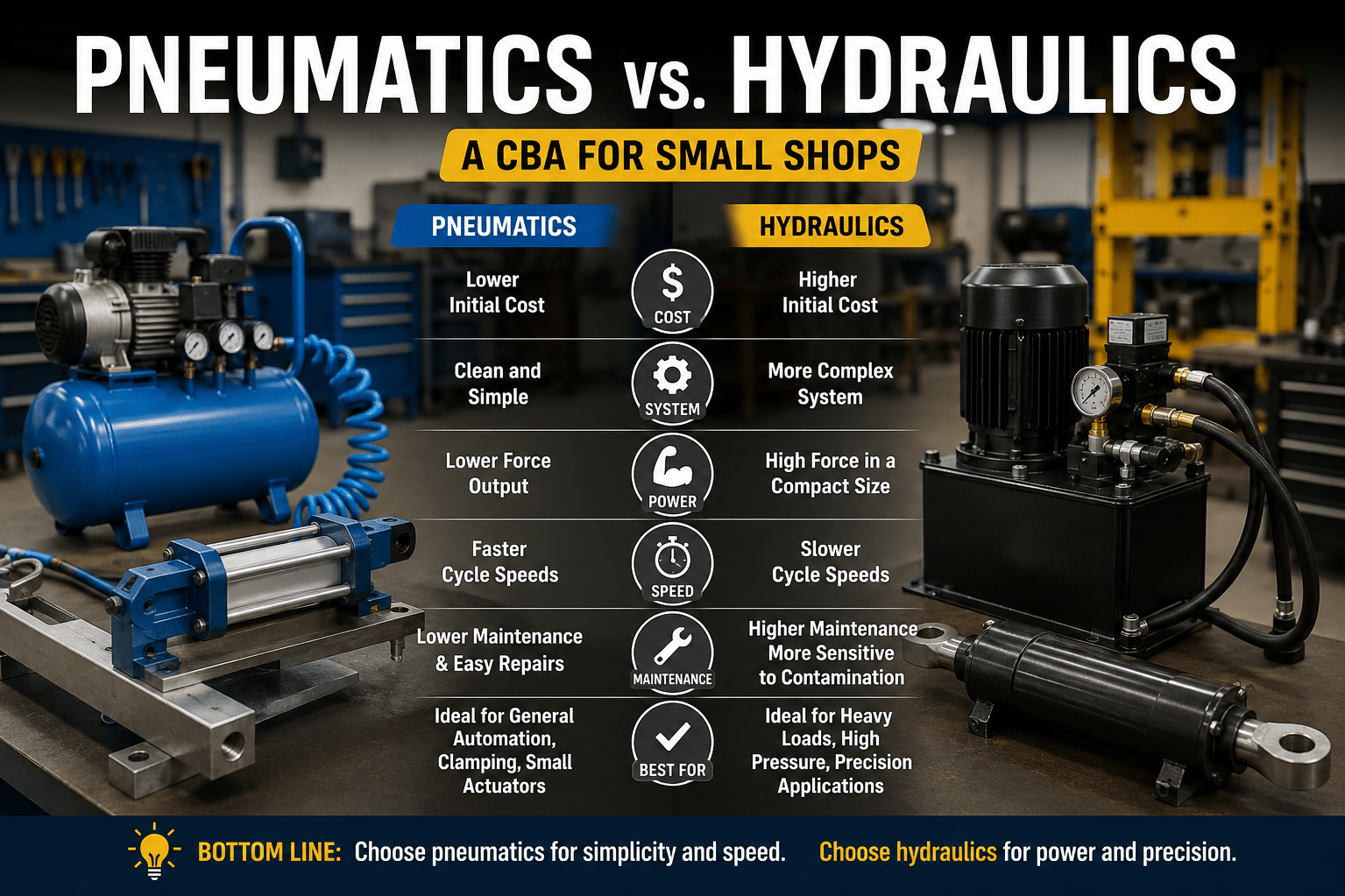
Pneumatics vs. Hydraulics: A CBA for Small Shops
Pneumatics vs. Hydraulics: A Cost-Benefit Analysis for Small Shops.
For a small shop, every square foot and every dollar in the maintenance budget counts. When you’re looking to automate a process—whether it’s a custom wood press, a parts feeder, or a specialized clamping jig—the debate usually boils down to two heavyweights: Pneumatics and Hydraulics.
While both systems use fluid power to get work done, they are worlds apart in terms of cost, complexity, and capability. In 2026, with energy prices fluctuating and smart components becoming more accessible, the right choice depends on your specific force and performance requirements.
Here’s a breakdown of how these two technologies stack up for small-shop operators.
Pneumatic systems are often the most economical choice for small shops.
1. Initial Investment: The Setup Cost
In the world of small shops, pneumatics is the undisputed king of low entry costs.
- Pneumatics: Most small shops already have a central air compressor. Adding a new pneumatic circuit often requires only tubing, a few valves, and an actuator. Even when starting from scratch, a quality compressor and FRL assembly are significantly less expensive than a hydraulic power unit.
- Hydraulics: These systems require a dedicated hydraulic power unit (HPU) consisting of a motor, pump, and reservoir. Because operating pressures are much higher, reinforced hoses and specialized fittings are required, often making the initial investment several times greater than a comparable pneumatic system.
2. Power and Precision: The Muscle Factor
This is where the balance shifts. If your application requires serious force, hydraulics have a clear advantage.
| Feature | Pneumatics (Air) | Hydraulics (Oil) |
|---|---|---|
| Operating Pressure | Typically 80–125 PSI | Typically 1,500–3,000+ PSI |
| Force Density | Moderate (ideal for light to medium-duty tasks) | High (up to 25 times more force than air) |
| Precision | Difficult due to air compressibility | Excellent because oil is incompressible |
| Speed | Very fast cycle times | Moderate to slow |
Small Shop Rule of Thumb: If you need to lift vehicles, press metal, or generate tons of force, choose hydraulics. If you’re moving lightweight parts repeatedly at high speeds, pneumatics is usually the better solution.
3. Maintenance and Cleanliness
Many small shops do not have dedicated maintenance personnel, making simplicity and cleanliness important considerations.
The Pneumatic Advantage
Pneumatic systems are inherently clean. When an air line leaks, you hear a hiss and lose efficiency, but there is no fluid contamination or cleanup required. Routine maintenance is typically limited to draining condensate and occasionally replacing inexpensive seals.
The Hydraulic Challenge
Hydraulic systems rely on oil, which means leaks can create slippery floors, contamination issues, and potential fire hazards. Operators must also manage filtration, fluid replacement, and cavitation risks that can damage pumps and other components. In clean production environments, hydraulic leaks can become costly very quickly.
4. Energy Efficiency: The Hidden Cost
Many shop owners are surprised by the energy discussion surrounding fluid power systems.
On paper, hydraulics are more energy-efficient because oil does not compress, reducing energy losses.
However, pneumatics can be more system-efficient for small shops. A single compressor can power multiple tools, blow-off stations, and automation circuits throughout the facility. Hydraulic systems often require dedicated pumps that may run continuously to maintain pressure, increasing electrical consumption if not equipped with modern controls such as variable frequency drives (VFDs).
The Final Verdict: Which Should You Choose?
Choose Pneumatics If:
- You are working with a limited budget.
- You need fast, repetitive motion.
- You operate in a clean environment such as woodworking, electronics, or food production.
- Your force requirements are generally under 500 pounds.
Choose Hydraulics If:
- You need extreme force for pressing, lifting, or crushing applications.
- You require precise positioning and load-holding capability.
- Space is limited but power requirements are high.
For most small shops, pneumatics offers the best combination of affordability, simplicity, speed, and cleanliness. Hydraulics remains the preferred choice when applications demand maximum force and precision.
Need Help Choosing the Right Fluid Power Solution?
Whether you’re building a new compressed air system, upgrading existing equipment, or trying to determine whether pneumatics or hydraulics is the right fit for your application, the team at Pneumatics Now is here to help.
From air compressors, dryers, and aluminum piping systems to valves, cylinders, FRLs, and replacement parts, we provide the products and expertise to keep your operation running efficiently.
Have questions or need a quote? Contact Pneumatics Now today and let our specialists help you find the right solution for your shop, facility, or automation project.
Pneumatics Now — Your Source for Pneumatic Components, Compressed Air Systems, and Support.