Pneumatic System Essentials
Harnessing Air: The 5 Essential Components of Any Pneumatic System
In the world of industrial automation, pneumatic systems are the unsung heroes. They are clean, cost-effective, and incredibly reliable. Whether it’s a high-speed packaging line or a heavy-duty assembly press, the underlying physics remains the same: using compressed gas to do work.
But what actually happens between the air intake and the final movement? To understand how these systems function, we have to look at the five core building blocks that make it all possible.
1. The Prime Mover (The Compressor)
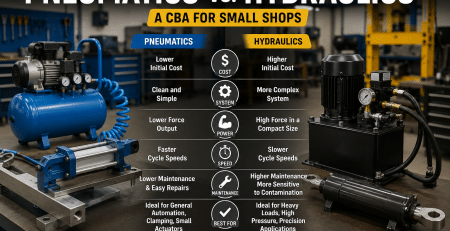
Every pneumatic system starts with the compressor. Think of this as the “heart” of the operation. Its job is to take ambient air from the atmosphere and squeeze it into a much smaller volume, increasing its pressure.
- Function: Converts mechanical energy (usually from an electric motor) into pneumatic energy.
- Pro Tip: Choosing the right compressor depends on your CFM (Cubic Feet per Minute) requirements and the desired operating pressure.
2. The Storage Tank (The Receiver)
Air compressors don’t usually feed the machines directly. Instead, they pump air into a receiver tank. This tank acts as a buffer or a battery for your air supply.
- Pressure Stabilization: It prevents the compressor from “short-cycling” (turning on and off constantly).
- Cooling: It allows the hot, compressed air to cool down, which helps moisture drop out of the air before it reaches your expensive tools.
3. The FRL Unit (The Life Support System)
If the compressor is the heart, the FRL unit (Filter, Regulator, Lubricator) is the kidney and nervous system. Compressed air is naturally dirty, wet, and inconsistent; the FRL unit fixes that.
- Filter: Removes water, oil, and particulates that can cause corrosion.
- Regulator: Ensures the system operates at a constant, safe pressure regardless of fluctuations at the tank.
- Lubricator: Adds a fine mist of oil to the air to keep moving parts sliding smoothly (though many modern “oil-free” systems skip this stage).

4. Control Valves (The Brains)
Now that we have clean, pressurized air, we need to tell it where to go. Directional control valves act as the switches of the system. They can be operated manually (levers), mechanically (rollers), or electrically (solenoids).
- The Job: Valves direct the flow of air to either extend or retract an actuator, or to stop the flow entirely.
- Logic: In complex systems, valves work together to create “pneumatic logic,” ensuring movements happen in a specific, timed sequence.
5. Actuators (The Muscle)
This is where the magic happens. The actuator is the component that converts that stored air pressure back into physical motion.
- Linear Actuators: Standard cylinders that push or pull in a straight line.
- Rotary Actuators: Pneumatic motors or vanes that create spinning motion.