Choosing Between Single and Double-Acting Cylinders
The Actuator Dilemma: Choosing the Right Cylinder for Force and Fluid Economy
In the world of pneumatics, selecting the right actuator is the difference between a machine that hums with efficiency and one that’s a constant maintenance headache. While there are dozens of specialized cylinders on the market, the vast majority of applications boil down to one fundamental choice: Single-Acting vs. Double-Acting.
If you’re staring at a spec sheet wondering which way to lean, here is a breakdown of how they work, where they shine, and which one will save you the most money in the long run.
1. Single-Acting Cylinders: The Simple Specialists
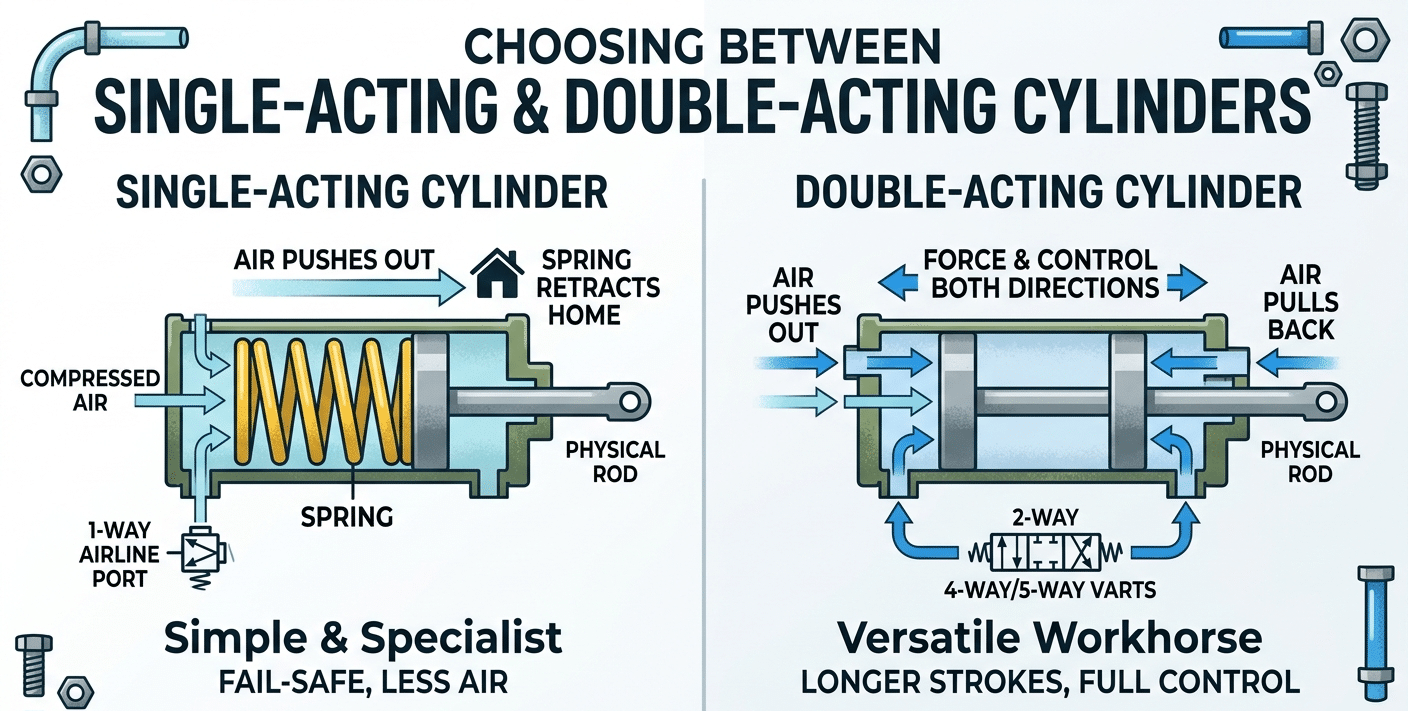
Single-acting cylinders use compressed air to drive the piston in one direction (usually extending) and a mechanical spring (or gravity) to return it to its original position.
The Pros:
-
- Safety First: If your system loses power or air pressure, the internal spring automatically returns the piston to a “home” position. This makes them excellent for fail-safe applications like emergency valves or brakes.
- Reduced Air Consumption: Since you only use air for one half of the cycle, you use significantly less compressed air over time.
- Simple Plumbing: You only need one airline and a simpler 3-way valve to operate them.
The Cons:
-
- Limited Stroke Length: Because the housing has to accommodate a physical spring, these cylinders are usually shorter.
- Reduced Force: The air pressure has to fight against the spring during the “push,” meaning you lose a bit of output force compared to a double-acting version of the same size.
2. Double-Acting Cylinders: The Versatile Workhorses
Double-acting cylinders use compressed air for both the extension and the retraction. There is no spring; instead, air is ported into one side to push the piston out, and then ported into the other side to pull it back.
The Pros:
-
- Total Control: You have full power and speed control in both directions. This is essential for tasks like opening and closing a heavy gate or precise assembly work.
- Longer Strokes: Without a bulky spring taking up space, these cylinders can be built with much longer stroke lengths—sometimes several feet long.
- Consistency: They provide a constant force throughout the entire movement because they aren’t fighting a spring.
The Cons:
-
- Higher Air Usage: You’re using “paid-for” compressed air for every single movement, which can add up in high-cycling environments.
- More Complex Setup: You’ll need two air lines and a 4-way (or 5-way) valve to manage the directional flow.
The Comparison at a Glance
| Feature | Single-Acting | Double-Acting |
|---|---|---|
| Power Direction | One-way (Push or Pull) | Two-way (Both) |
| Fail-Safe | Yes (Spring Return) | No (Stays in place/drifts) |
| Air Efficiency | High (uses 50% less air) | Lower |
| Stroke Length | Generally short | Virtually unlimited |
| Complexity | Low (1 port) | Medium (2 ports) |
How to Decide?
To pick the winner for your application at Pneumatics Now, ask yourself these three questions:
- Does it need to fail-safe? If the piston must retract if the power cuts out, go Single-Acting.
- Is the stroke longer than 4 inches? If yes, you’ll likely need a Double-Acting cylinder to avoid a massive, impractical housing.
- Do you need force in both directions? If you are pushing a load and then pulling it back, Double-Acting is your only real choice.
The Verdict: If your task is a simple “push and forget” (like an ejector arm or a stamp), the Single-Acting cylinder is a cost-effective, air-saving gem. For everything else, clamping, lifting, or long-distance movement—the Double-Acting cylinder is the industry standard for a reason.
Get the Right Actuator for Your Application
Still unsure which cylinder fits your system requirements or fluid budget? Don’t leave your machinery’s efficiency to guesswork. Contact our team today to request a quote on pneumatic solutions.